
A Pilates reformer brings strength, mobility, and mindful movement into one versatile workout. With its sliding carriage, adjustable springs, and straps, it offers different ways to challenge your muscles while developing balance and control.
Whether you are exploring reformer Pilates for the first time or creating a dedicated workout space at home, understanding the equipment and its movements is a useful place to start.
Get to Know Your Pilates Reformer
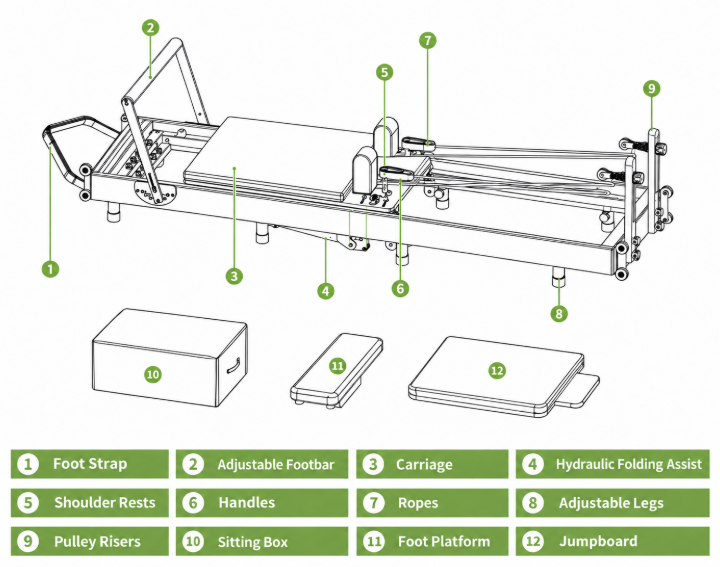
Each part of a reformer serves a purpose. The carriage supports your body as it moves along the frame, while the springs provide resistance or assistance, depending on the exercise. The adjustable footbar gives your feet or hands a stable contact point, and the ropes, handles, and pulleys support a variety of upper- and lower-body movements.
Accessories such as a sitting box and jumpboard expand the range of exercises. On the model pictured, adjustable legs offer setup options, while the hydraulic folding assist helps with storage.
One detail to remember: lighter springs do not always make an exercise easier. In some movements, less spring support creates a greater stability challenge. Choose settings appropriate to the exercise and follow your equipment’s instructions.
What Are the Benefits of Reformer Pilates?
Core strength and control. Keeping your torso steady while your arms, legs, or carriage move challenges the muscles that support your trunk and pelvis.
Strength and flexibility. Spring resistance provides muscular work, while controlled movements help you explore a comfortable range of motion.
Balance and coordination. Pilates encourages you to pay attention to alignment, breathing, and how different parts of your body move together.
Low-impact movement. Many reformer exercises avoid jumping or hard landings, offering a way to train with less impact while still challenging your muscles.
Regular Pilates practice may support strength, flexibility, balance, and posture. Individual results depend on your starting point, technique, and consistency.
Three Exercises for Mobility and Stability
The following movements highlight how controlled stretching and targeted muscle work can complement each other.
1. Seated Forward Stretch
Sit tall with your legs extended and feet supported. Gently round your upper back and reach forward, allowing your shoulders to stay relaxed. Return upright slowly rather than pulling yourself forward with your arms.
This movement emphasizes back flexibility, spinal mobility, and core control. A comfortable, controlled stretch matters more than how far you reach.
2. Side-Lying Leg Lift
Lie on your side with your head supported and hips stacked. Raise your straight top leg slowly, then lower it without rolling your pelvis or swaying your torso.
This exercise targets the outer hips and glutes while challenging pelvic stability. Keep the range small enough to maintain steady alignment.
3. Kneeling Forward Stretch
With the carriage secured against unintended movement, kneel comfortably and ease your hips toward your heels. Reach forward gently and allow your back and shoulders to lengthen as you breathe.
The focus is back and shoulder mobility and body awareness. Avoid forcing the stretch or placing excessive tension through your shoulders.
Three Exercises for Strength and Coordination
These movements introduce lower-body pushing, abdominal endurance, and upper-body pulling for a varied training routine.
4. Supine Footwork
Lie on your back with your feet securely on the footbar. Extend your legs to move the carriage away, keeping your knees aligned with your toes. Bend your knees slowly to return without letting the carriage snap back.
Footwork trains the legs and glutes while encouraging lower-body alignment and core stability. Avoid locking your knees at the end of the movement.
5. The Hundred
Gently lift your head and shoulders while keeping your neck comfortable. Hold your knees bent, or extend your legs diagonally if you can maintain control. Reach your arms alongside your body and pulse them gently, inhaling for five counts and exhaling for five.
The Hundred develops abdominal endurance and breath coordination. Start with fewer pulses and build gradually; rest your head or support your legs when needed.
6. Seated Row
Sit tall facing the pulleys, holding a handle in each hand. Draw your elbows back close to your sides, then slowly extend your arms to return. Keep your shoulders relaxed and avoid rocking your torso.
This movement strengthens the upper back and arms while developing shoulder control. Focus on smooth movement rather than pulling as far or as hard as possible.
Bring Consistent Movement into Your Home
A home reformer makes it easier to set aside time for movement without a commute. Foldable designs also allow your workout area to share space with everyday living.
Before each session, check that the springs, footbar, ropes, and folding locks are secure. Treat these illustrations as an introduction rather than a complete setup guide, and follow the instructions for your specific reformer. Move within a comfortable range and stop if you experience pain.
Start with movements you can control, build confidence gradually, and let consistency guide your progress.
Find a reformer that fits your home and your routine at ACTSHE.com.

Leave a comment
This site is protected by hCaptcha and the hCaptcha Privacy Policy and Terms of Service apply.