
Finding the right Pilates reformer for your home is about more than choosing a piece of fitness equipment. It's about creating a workout space that fits your lifestyle, supports your routine, and makes movement a natural part of your day.
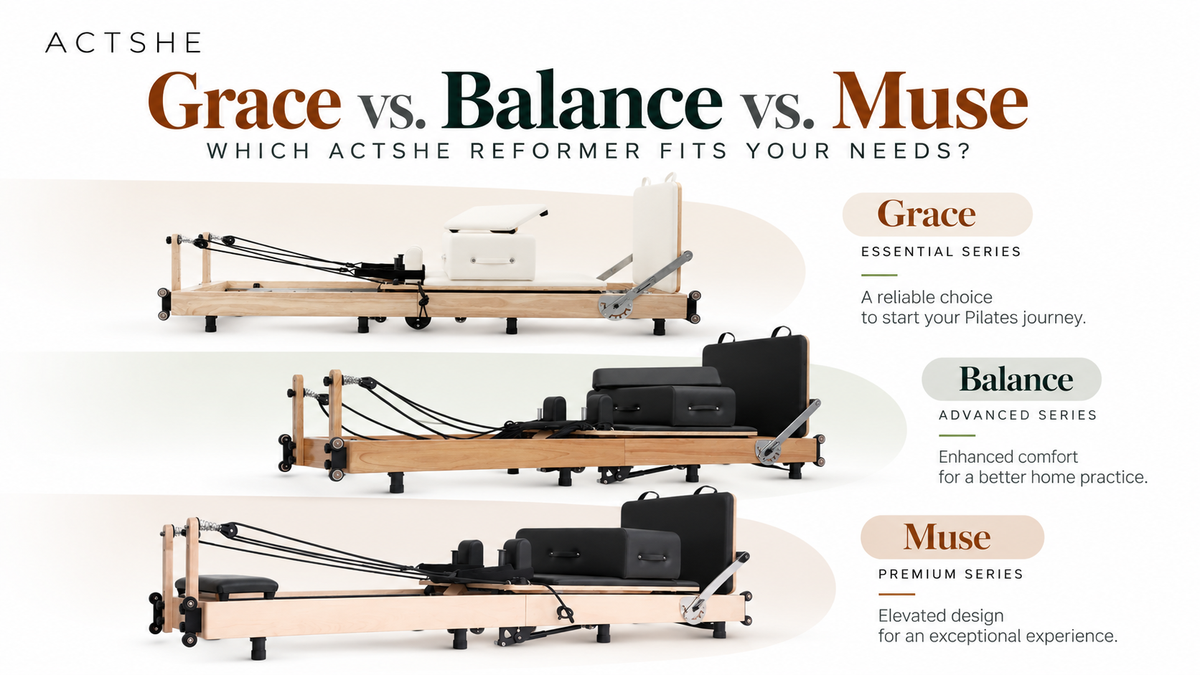
At ACTSHE, we believe that everyone deserves a Pilates experience that feels right for them. That's why our foldable Pilates reformer collection includes three distinct series: Grace, Balance, and Muse.
Each series offers a different combination of materials, folding convenience, and design priorities.
Whether you're starting your Pilates journey, looking to upgrade your home workout setup, or creating a premium wellness space, understanding the differences can help you make a more confident decision.
In this guide, we'll compare ACTSHE Grace vs. Balance vs. Muse, explore their key features, and help you discover which Pilates reformer best fits your needs.
Meet the ACTSHE Pilates Reformer Collection
ACTSHE's three reformer series are designed around different home fitness preferences.
Grace Series: Essential Home Pilates
The ACTSHE Grace Series is our essential collection, offering a practical starting point for people who want to bring reformer Pilates into their homes.
Featuring an oak wood frame, a manual folding system, and stainless steel rails, Grace focuses on the core features of a home Pilates reformer.
It's a thoughtful option for users who value straightforward functionality and a natural wooden design.
Balance Series: An Advanced Home Pilates Experience
The ACTSHE Balance Series builds on the essential experience with features that prioritize everyday convenience.
Like Grace, Balance features an oak wood frame. However, it introduces a hydraulic-assisted folding system and aluminum alloy rails.
These differences make Balance an appealing option for users seeking an upgraded home Pilates setup, particularly those who expect to fold and store their equipment regularly.
Muse Series: Premium Pilates Design
The ACTSHE Muse Series represents the premium tier of our foldable reformer collection.
Featuring a maple wood frame, hydraulic-assisted folding, and aluminum alloy rails, Muse emphasizes refined materials and an elevated design experience.
It's designed for users who appreciate the combination of home fitness functionality and sophisticated aesthetics.
Grace vs. Balance vs. Muse: Side-by-Side Comparison
Before exploring each model in detail, here's a quick overview of the key differences.
| Feature | Grace | Balance | Muse |
|---|---|---|---|
| Series Positioning | Essential | Advanced | Premium |
| Frame Material | Oak Wood | Oak Wood | Maple Wood |
| Folding System | Manual Folding | Hydraulic-Assisted Folding | Hydraulic-Assisted Folding |
| Rail Material | Stainless Steel | Aluminum Alloy | Aluminum Alloy |
| Number of Springs | 6 | 6 | 6 |
| Primary Appeal | Essential Functionality | Folding Convenience | Premium Materials & Design |
All three series feature foldable designs and six resistance springs.
The main differences lie in their frame materials, rail construction, folding mechanisms, and overall positioning.
The best ACTSHE reformer isn't necessarily the highest-tier model. It's the one that matches your preferences, available space, and daily routine.
ACTSHE Grace: A Practical Starting Point for Home Pilates
If you're looking for a straightforward way to enjoy reformer Pilates at home, the Grace Series is an excellent place to begin your search.
As ACTSHE's essential collection, Grace focuses on practical functionality without unnecessary complexity.
Natural Oak Wood Construction
Grace features an oak wood frame that brings a warm, natural appearance to your home workout environment.
Wooden reformers can complement a variety of interior styles, from minimalist apartments to dedicated fitness rooms.
The oak frame gives Grace a classic aesthetic while providing the structural foundation for its Pilates components.
Manual Folding Design
One of Grace's defining features is its manual folding system.
This allows the reformer to be folded for storage according to the manufacturer's instructions.
For users who don't mind a hands-on folding process, manual folding can be a practical solution.
Before purchasing, consider how frequently you'll need to fold and unfold the equipment and whether the process suits your needs.
Stainless Steel Rail System
Grace uses stainless steel rails to guide carriage movement.
Rail material is one factor to consider when evaluating a reformer, although the overall movement experience also depends on carriage construction, wheel design, alignment, and maintenance.
Who Should Choose Grace?
Grace may be the right fit if you:
- Are exploring your first home Pilates reformer.
- Prefer essential features over upgraded conveniences.
- Appreciate natural oak wood construction.
- Are comfortable with a manual folding mechanism.
- Want a foldable reformer for regular home practice.
Our recommendation: Choose Grace if your priority is a straightforward, essential home Pilates setup.
ACTSHE Balance: Enhanced Convenience for Your Pilates Routine
The Balance Series is designed for users who want to move beyond the essentials and enjoy additional convenience in their home workout routine.
Balance retains the oak wood construction of Grace while introducing two notable differences: hydraulic-assisted folding and aluminum alloy rails.
Oak Wood Frame with an Elevated Design
Like Grace, Balance features an oak wood frame.
This gives it a natural appearance that can blend into modern home environments.
The difference between the two series isn't simply the wood material. It's the combination of construction choices and convenience-focused features.
Hydraulic-Assisted Folding
One of Balance's most important upgrades is its hydraulic-assisted folding system.
Unlike Grace's manual folding design, Balance incorporates hydraulic assistance during the folding process.
This can be especially appealing if you plan to set up and store your reformer frequently.
However, hydraulic assistance doesn't mean the machine is weightless or that folding requires no effort. Always follow the product's instructions and safety requirements.
Aluminum Alloy Rail System
Balance features aluminum alloy rails rather than the stainless steel rails used in Grace.
Aluminum alloy is commonly valued in equipment design for its strength-to-weight characteristics, although the performance of a complete rail system depends on more than material alone.
When comparing the two models, consider the full construction and intended use rather than assuming one rail material automatically delivers better exercise results.
Who Should Choose Balance?
Balance may be a good fit if you:
- Already enjoy Pilates and want to invest in your home routine.
- Prefer hydraulic-assisted folding.
- Expect to fold and store your equipment frequently.
- Appreciate oak wood construction.
- Want an advanced series with convenience-focused features.
Our recommendation: Choose Balance if folding convenience is a major factor in your buying decision and you prefer the appearance of oak wood.
ACTSHE Muse: Premium Materials for an Elevated Home Studio
For those who appreciate refined materials and sophisticated design, the Muse Series offers ACTSHE's premium reformer experience.
Muse combines maple wood construction with hydraulic-assisted folding and aluminum alloy rails.
Premium Maple Wood Frame
One of the clearest differences between Muse and the other two series is its frame material.
While Grace and Balance use oak wood, Muse features a maple wood frame.
Maple is known for its fine, relatively uniform grain and is often selected for furniture and interior applications where a refined wood appearance is desired.
This gives Muse a distinct material identity within the ACTSHE collection.
However, maple isn't automatically superior to oak in every application. Both materials have their own characteristics, and the quality of a finished reformer depends on its complete construction.
Hydraulic-Assisted Folding System
Like Balance, Muse features hydraulic-assisted folding.
This offers a convenience-focused alternative to Grace's manual folding mechanism.
For people who want premium design without giving up foldable functionality, Muse provides both features in one series.
Aluminum Alloy Rails and Six Springs
Muse uses aluminum alloy rails and includes six resistance springs, matching the rail material and spring count of Balance.
Based on these confirmed specifications, the distinction between Balance and Muse is primarily their frame material and series positioning.
It's important not to assume that Muse automatically provides greater resistance, better training outcomes, or more advanced exercise capabilities simply because it's the premium series.
Who Should Choose Muse?
Muse may be right for you if you:
- Appreciate premium home fitness equipment.
- Prefer the appearance of maple wood.
- Want hydraulic-assisted folding.
- Are creating a thoughtfully designed home Pilates space.
- Value materials and aesthetics as part of the ownership experience.
- Our recommendation: Choose Muse if premium materials and refined design are central to your ideal home Pilates setup.
Key Differences That Matter Most
Although Grace, Balance, and Muse share the same general purpose, several features can influence which one feels right for your home.
1. Oak vs. Maple Wood: Choosing Your Preferred Material
Grace and Balance feature oak wood frames, while Muse features maple wood.
Both are hardwoods commonly used in furniture and equipment construction.
Oak often has a more pronounced grain pattern, while maple typically offers a finer, more uniform appearance.
The choice may come down to personal preference and how the equipment fits your interior design.
Neither wood type should be considered universally stronger or better without evaluating the specific construction and material grade.
2. Manual vs. Hydraulic-Assisted Folding
Folding convenience is one of the most meaningful practical differences between the three series.
Grace: Manual Folding
Grace requires a manual folding process.
This may suit users who don't need to fold their equipment frequently or who prefer a simpler folding mechanism.
Balance and Muse: Hydraulic-Assisted Folding
Both Balance and Muse incorporate hydraulic assistance.
This may be particularly useful for users who regularly transition between workout and everyday living spaces.
If you expect to fold your reformer after most sessions, this difference deserves special attention.
3. Stainless Steel vs. Aluminum Alloy Rails
Grace uses stainless steel rails, while Balance and Muse use aluminum alloy rails.
Both materials can be used in quality equipment construction.
However, rail material alone doesn't determine stability, smoothness, durability, or the overall workout experience.
Those qualities also depend on engineering, manufacturing, assembly, and maintenance.
For a complete comparison, consider the reformer's overall specifications and manufacturer guidance.
4. Resistance Springs: What Do All Three Have in Common?
Grace, Balance, and Muse each feature six springs.
This is an important similarity across the collection.
However, the number of springs doesn't tell you everything about resistance.
Actual resistance depends on spring specifications, combinations, attachment positions, and the exercises performed.
Based on the confirmed information, there is no reason to assume that Muse offers greater resistance than Balance or Grace solely because of its premium positioning.
5. Design and Everyday Convenience
When choosing between the three series, think about how you'll interact with your reformer outside the workout itself.
Will you leave it set up in a dedicated room?
Will you fold it after every session?
Do you prefer the appearance of oak or maple?
Are you primarily looking for essential functionality, added convenience, or premium materials?
These questions can be more useful than simply choosing the most expensive option.
Which ACTSHE Pilates Reformer Should You Choose?
Still deciding? Here are three common buying scenarios.
Choose Grace If You Want the Essentials
Grace is a practical choice for users who want to begin or maintain a home Pilates routine with a straightforward foldable reformer.
Its oak frame, manual folding design, stainless steel rails, and six springs provide the defining features of ACTSHE's essential series.
Best fit: Buyers who prioritize core functionality and are comfortable with manual folding.
Choose Balance If Convenience Matters Most
Balance is worth considering if you like the natural appearance of oak but want hydraulic-assisted folding.
Its aluminum alloy rails and advanced-series positioning distinguish it from Grace.
Best fit: Users who value folding convenience and want an upgraded home equipment experience.
Choose Muse If You Prefer Premium Materials
Muse is the premium choice for buyers who appreciate maple wood construction and refined design.
With hydraulic-assisted folding, aluminum alloy rails, and six springs, it shares several practical features with Balance while offering a different frame material.
Best fit: Buyers who prioritize premium materials, aesthetics, and convenient folding.
Quick Decision Guide
Choose Grace when: You want essential functionality and manual folding works for your lifestyle.
Choose Balance when: You prefer oak wood and want hydraulic-assisted folding.
Choose Muse when: You prefer maple wood and want ACTSHE's premium design series.
No matter which series you choose, consider your available space, experience level, budget, and intended workout routine before purchasing.
Frequently Asked Questions
What is the difference between ACTSHE Grace, Balance, and Muse?
The main differences are frame materials, folding mechanisms, rail materials, and series positioning.
Grace is the essential series with an oak wood frame, manual folding, and stainless steel rails.
Balance is the advanced series with an oak wood frame, hydraulic-assisted folding, and aluminum alloy rails.
Muse is the premium series with a maple wood frame, hydraulic-assisted folding, and aluminum alloy rails.
All three have six springs.
Is ACTSHE Grace good for beginners?
Grace is ACTSHE's essential series and may be a suitable option for people building their first home Pilates setup.
However, beginners should learn proper reformer operation and exercise technique with qualified instruction before practicing independently.
Is Balance better than Grace?
Balance offers hydraulic-assisted folding and aluminum alloy rails, while Grace features manual folding and stainless steel rails.
Whether these differences make Balance a better choice depends on your needs.
If folding convenience matters most, Balance may be more appealing. If you prefer essential functionality, Grace may be sufficient.
What makes ACTSHE Muse the premium series?
Muse features a maple wood frame, which distinguishes it from the oak wood construction of Grace and Balance.
It also includes hydraulic-assisted folding and aluminum alloy rails.
Its premium positioning emphasizes materials and design rather than an unverified claim of superior workout performance.
Do all three ACTSHE reformers have the same number of springs?
Yes. Based on the confirmed product comparison, Grace, Balance, and Muse each feature six springs.
Spring count alone doesn't establish identical resistance levels, so review the individual spring specifications for more detailed resistance comparisons.
Are all ACTSHE reformers foldable?
Yes. Grace, Balance, and Muse are all foldable series.
Grace uses manual folding, while Balance and Muse use hydraulic-assisted folding.
Always follow the manufacturer's folding, handling, and storage instructions.
Which ACTSHE reformer is best for small spaces?
All three series offer foldable designs, which can be useful in multipurpose rooms.
However, the best option for your space depends on the unfolded dimensions, folded dimensions, clearance requirements, and approved storage method.
Check the exact specifications before purchasing.
Is Muse better for Pilates workouts than Balance?
Not necessarily.
Muse and Balance both feature hydraulic-assisted folding, aluminum alloy rails, and six springs.
The confirmed difference in frame material is maple for Muse and oak for Balance.
There isn't enough information to conclude that one produces better exercise results than the other.
Final Thoughts: Find Your Perfect ACTSHE Reformer
Choosing between Grace, Balance, and Muse comes down to what matters most to you.
If you're looking for essential functionality and a straightforward introduction to home reformer ownership, Grace is a practical starting point.
If you value convenient folding and an advanced equipment experience, Balance offers features worth considering.
And if premium materials and refined aesthetics are your priorities, Muse brings maple wood construction into your home Pilates space.
Each series reflects a different approach to the home Pilates experience, but all three are designed to help you make room for movement in everyday life.
The right reformer isn't simply the one with the most premium label.
It's the one you'll feel comfortable using, maintaining, and incorporating into your routine.
Find Your Fit with ACTSHE
Whether you're beginning your Pilates journey or upgrading your home workout space, ACTSHE offers foldable reformers designed for different preferences and lifestyles.
Explore the Grace, Balance, and Muse collections, compare their features, and choose the Pilates reformer that feels right for you.
Explore ACTSHE Pilates Reformers
Three series. Different priorities. One goal: bringing Pilates into your everyday life.

Leave a comment
This site is protected by hCaptcha and the hCaptcha Privacy Policy and Terms of Service apply.